Which One of These Ancient Civilization Created Art for Arts Sake?
In the course of human development, the practice of living in a grouping with mutual understanding and dependency has become a very useful and practical lifestyle, and from pocket-sized isolated groups, larger communities have formed. And so came societies which in time became civilizations. How human being mentality and psychology led to this evolution is still a pop topic amongst historians and anthropologists, and a major give-and-take for some other 24-hour interval. For now, permit'south talk nigh some of the oldest civilizations to take ever existed in the world. Nosotros are talking about the civilizations that nosotros know existed for real, unlike the ones that are shrouded in myth such equally Atlantis, Lemuria, and Rama to name a few. To correctly list the oldest civilizations in chronological order, it is necessary to go back to the very cradle of civilization. Here is a list of the top x oldest civilizations to have ever existed, starting with the most recent commencement:
x. The Incan Civilization
Culture Proper noun: Incan civilization
Period: 1438 AD–1532 AD
Original Location: Present-day Republic of peru
Current Location: Ecuador, Peru, and Chile
Major Highlights: Largest empire in Due south America in the pre-Columbian era
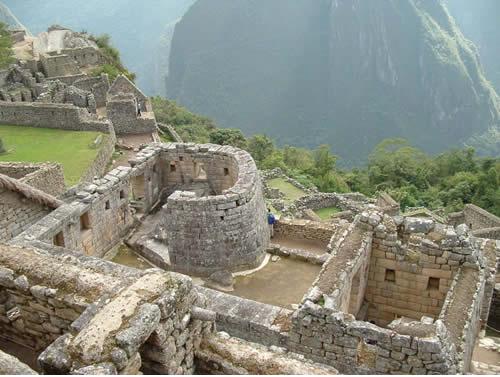
The Incan Empire was the largest empire in South America in the pre-Columbian era. This civilization flourished in the areas of present-day Republic of ecuador, Peru, and Chile and had its administrative, military machine, and political center at Cusco which lies in mod-day Republic of peru.
The Incan civilization was a well-established and flourishing society. The Incas were devout followers of the dominicus god Inti, and their king was referred to as "Sapa Inca" pregnant the child of the sun. The first Incan emperor, Pachacuti, transformed the capital from a modest village into a nifty city laid out in the shape of a puma. He continued to aggrandize the tradition of ancestor worship. When the male monarch died, his son would get all the ability, just his wealth would exist distributed among his other relatives, who in return would preserve his mummy and maintain his political influence. This led to a pregnant rise in the power of the Incas who went on to become great builders, constructing fortresses and sites like Machu Picchu and the city of Cusco that nonetheless stand up to this day.
9. The Aztec Culture
Civilization Proper noun: Aztec civilization
Period: 1345 AD–1521 AD
Original Location: Southcentral region of pre-Columbian Mexico
Current Location: Mexico
Major Highlights: Nahuatl became the major linguistic communication
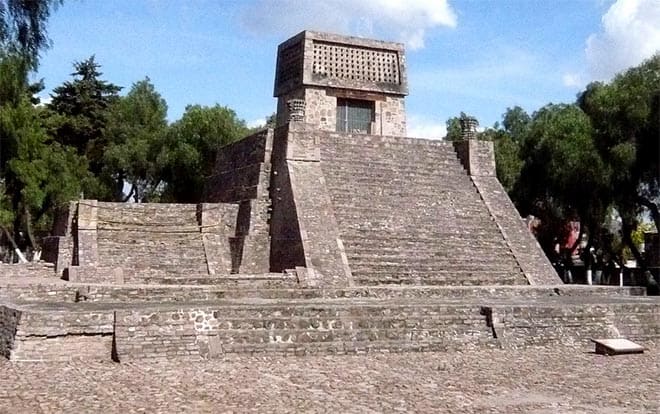
The Aztecs came on to the scene pretty much around the time when the Incas were emerging as powerful contenders in South America. Around the 1200s and early on 1300s, the people in present-day United mexican states lived in three large rival cities – Tenochtitlan, Texcoco, and Tlacopan. Around 1325, these rivals created an alliance and the new state came to dominate the Valley of United mexican states. Back then, the people preferred the name Mexica to Aztecs. The rising of the Aztecs was within a century of the fall of another influential civilization in Mexico and Central America – the Mayans.
The city of Tenochtitlan was the military power base of operations and became a spearhead for the conquest of new territory, only the Aztec emperor didn't rule every city or region directly. Local governments remained in identify and were forced to pay varying amounts of tribute to the Triple Brotherhood. In the early 1500s, the Aztec civilization was indeed at the pinnacle of its ability. But then, the Spanish arrived. This led to a huge boxing between the Incas and the Spanish conquistadors and the native allies they had assembled led by the famous (or rather infamous) Hernan Cortes in 1521. A defeat in this decisive boxing somewhen led to the fall of the once-famous Aztec Empire.
viii. The Roman Culture
Civilization Name: Roman civilization
Menses: 550 BC–465 Ad
Original Location: Village of the Latini
Current Location: Rome
Major Highlights: Most powerful ancient culture
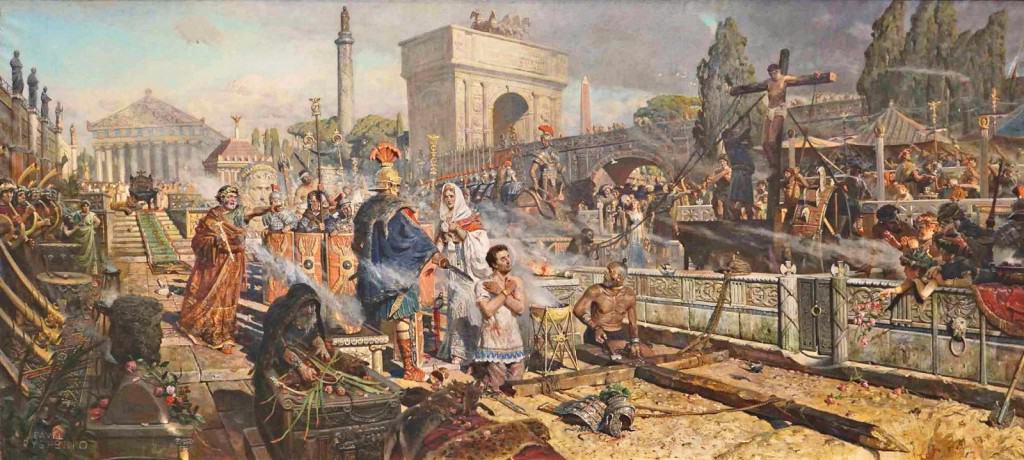
Roman civilization emerged around the sixth century BC. Even the story behind the foundation of ancient Rome is the stuff of fable and myth. At the acme of its power, the Roman Empire ruled over a huge chunk of land, and all the present-24-hour interval Mediterranean countries were part of ancient Rome.
Early on Rome was governed by kings, but afterward simply seven of them had ruled, the people took control over their own city and ruled themselves. They introduced a council known every bit the Senate which ruled over them. From this indicate, Rome was referred to equally the Roman Republic.
Rome also saw the rise and fall of some of the greatest emperors in human history, similar Julius Caesar, Trajan, and Augustus. Simply eventually, the empire became so vast that it was simply not possible to bring it under unmarried dominion. In the cease, the Roman Empire was overrun by millions of barbarians from the north and eastward of Europe.
Come across also:
- Acme 10 Religious Practices in Aboriginal Rome
- Pinnacle 10 Famous People in Ancient Rome
- Top ten Important Events in the History of Ancient Roman (BC)
- Superlative 10 Ancient Roman Inventions
seven. The Persian Civilization
Civilization Proper noun: Persian civilization
Period: 550 BC–331 BC
Original Location: Egypt in the west to Turkey in the north, and through Mesopotamia to the Indus river in the e
Current Location: Modern-day Islamic republic of iran
Major Highlights: Purple road
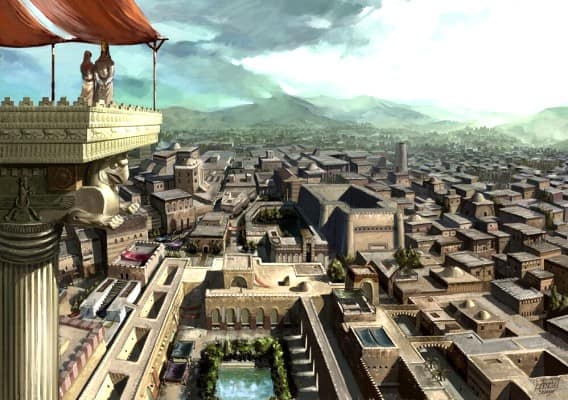
There was a time when the ancient Persian civilization was, in fact, the most powerful empire in the earth. Though only in power for a picayune over 200 years, the Persians conquered lands that covered over two one thousand thousand square miles. From the southern parts of Arab republic of egypt to parts of Hellenic republic and due east to parts of India, the Farsi Empire was known for its military strength and wise rulers.
Before they created such a vast empire in the infinite of just 200 years, before 550 BC, Persia (or Persis as it was called back and so) was divided into factions among a number of leaders. Merely so Male monarch Cyrus II, who after on became known as Cyrus the Great, came into power and unified the entire Western farsi kingdom before going on to conquer ancient Babylon. In fact, his conquest was and then rapid that by the cease of 533 BC, he had already invaded India, far in the east. Fifty-fifty later on Cyrus' decease, his descendants continued this ruthless expansion and even fought in the now legendary battle with the brave Spartans. At its prime number, ancient Persia ruled over all of central Asia and Egypt. But this all changed when a legendary soldier of Macedon, Alexander the Great, brought the whole Persian Empire to its knees and effectively ended the culture in 330 BC.
6. The Ancient Greek Civilisation
Civilization Name: Greek civilisation
Period: 2700 BC–479 BC
Original Location: Italy, Sicily, Due north Africa, and as far west as France
Electric current Location: Greece
Major Highlights: Concepts of democracy and the Senate, the Olympics
The aboriginal Greeks may not have been the oldest civilisation, but they are doubtlessly one of the most influential. Even though the rise of ancient Greece came from the Cycladic and Minoan civilizations (2700 BC–1500 BC), in that location is bear witness of burials in the Franchthi Cave in Argolid, Greece, dating back to around 7250 BC. The history of this civilization is spread over such a long menses of time that historians have divided information technology into different periods, the well-nigh popular of them beingness the Archaic, Classical, and Hellenistic periods. These periods saw a number of ancient Greeks come into the limelight, many of whom changed the world forever and are yet existence talked about to this twenty-four hour period.
Among other things, the Greeks invented the ancient Olympics, and formed the concept of commonwealth and the Senate. They laid the foundations for modern geometry, biological science, and physics. Pythagoras, Archimedes, Socrates, Euclid, Plato, Aristotle, Alexander the Great… the history books are full of these names whose inventions, theories, beliefs, and heroics have had a significant touch on subsequent civilizations.
Meet also:
- Meridian x Most Important People in Ancient Greece
- Meridian 10 Famous Clothes in Ancient Greece
- Pinnacle 10 Inventions and Discoveries of Ancient Greece
- Top x Ancient Greek Goddesses
- Pinnacle 10 Ancient Greek Gods
v. The Chinese Civilization
Civilization Name: Chinese civilization
Period: 1600 BC–1046 BC
Original Location: Yellowish River and Yangtze region
Current Location: Country of China
Major Highlights: Invention of paper and silk
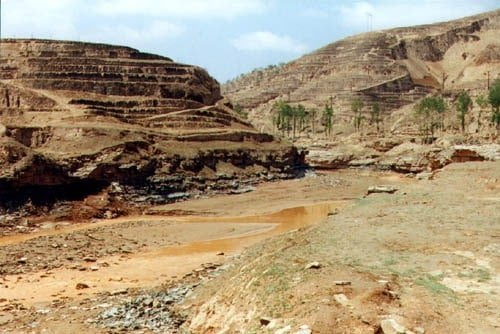
Ancient China – likewise known as Han China – comes in at number v and doubtlessly has 1 of the most diverse histories. In fact, if you consider all the dynasties from the very first to the very final that always ruled in China, a significantly huge menstruation of fourth dimension needs to exist covered.
The Yellow River civilization is said to be the beginning of the unabridged Chinese culture every bit this is where the primeval dynasties were based. It was around 2700 BC that the legendary Yellow Emperor began his rule, which later led to the birth of many dynasties that went on to rule mainland China.
In 2070 BC, the Xia dynasty became the start to rule the whole of Prc as described in ancient historical chronicles. From then on, there were a number of dynasties that held control during dissimilar periods of fourth dimension until the end of the Qing dynasty in 1912 AD with the Xinhai Revolution. This marked the end of more than than four millennia of ancient Chinese civilization. Past this time, however, the Chinese had given the world some of its virtually useful inventions and products such equally gunpowder, paper, printing, the compass, booze, cannons, and many more.
See also:
- Pinnacle xviii Ancient Chinese Inventions and Discoveries
- Peak 10 Astonishing Aboriginal Chinese Mythology Stories
- Top 10 Marvelous Pieces of Ancient Chinese Fine art
4. The Maya Civilization
Civilization Proper name: Maya civilization
Menstruation: 2600 BC–900 Advert
Original Location: Effectually present-24-hour interval Yucatan
Current Location: Yucatan, Quintana Roo, Campeche, Tabasco, and Chiapas in Mexico and southward through Guatemala, Belize, El Salvador, and Republic of honduras
Major Highlights: Complex understanding of astronomy
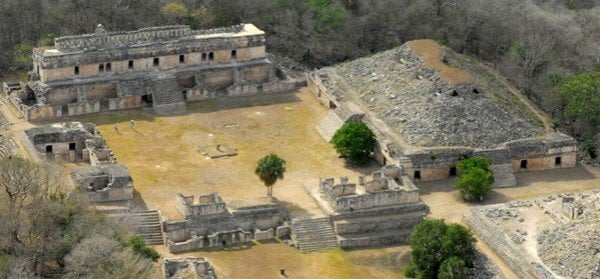
The ancient Maya culture flourished in Central America from about 2600 BC and has been much talked nigh considering of the calendar it introduced. Once established, the Mayan civilization went on to prosper and become highly sophisticated with a booming population of about xix 1000000 at its tiptop. By 700 BC, the Mayans had already devised their own system of writing which they used to create solar calendars carved in stone. According to them, the world was created on August eleven, 3114 BC, which is the date from which their calendar begins. The supposed end appointment was December 21, 2012.
The aboriginal Mayans were culturally rich compared to many of their contemporary civilizations, and the Mayans and Aztecs both built pyramids, many of which are larger than those in Egypt. But the sudden turn down and abrupt end of the Mayans has long been ane of ancient history's well-nigh intriguing mysteries: Why did the Mayans, a remarkably sophisticated culture made upwardly of more than 19 million people, suddenly collapse onetime during the 8th or ninth century? The Maya people did not disappear completely however; their descendants still live in parts of Key America.
Encounter also:
Top 10 Inventions of the Mayan Civilization
iii. The Ancient Egyptian Civilization
Civilization Name: Egyptian civilization
Flow: 3150 BC–30 BC
Original Location: Banks of the Nile
Electric current Location: Egypt
Major Highlights: Construction of pyramids
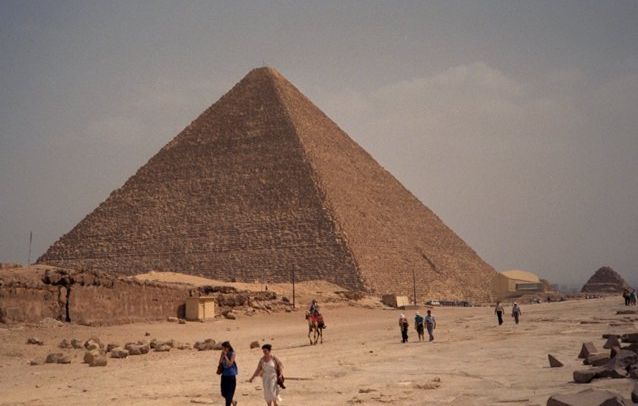
Ancient Egypt is ane of the oldest and culturally rich civilizations on this list. The ancient Egyptian civilization, a majestic civilization from the banks of the Nile, is known for its prodigious civilization, its pharaohs, the indelible pyramids, and the Sphinx.
The civilization coalesced around 3150 BC (according to conventional Egyptian chronology) with the political unification of Upper and Lower Egypt nether the first pharaoh. But this would not have been possible had at that place not already been settlers around the Nile valley in early 3500 BC.
The history of ancient Egypt tin be divided into a series of stable kingdoms separated by periods of relative instability known as intermediate periods: The One-time Kingdom of the Early Bronze Age, the Centre Kingdom of the Middle Bronze Age and the New Kingdom of the Late Statuary Age.
Ancient Arab republic of egypt gave us the pyramids, the mummies that preserve the ancient pharaohs to this day, hieroglyphics, and much more than. Aboriginal Arab republic of egypt reached its tiptop during the New Kingdom, when pharaohs like Ramesses the Dandy ruled with such authority that another gimmicky civilization, the Nubians, too came under Egyptian rule.
See also:
- Top 10 Ancient Egyptian Gods
- Top 10 Ancient Egyptian Paintings
two. The Indus Valley Civilisation
Civilization Name: Indus Valley civilisation
Period: 3300 BC–1900 BC
Original Location: Effectually the bowl of the Indus river
Current Location: Northeast Afghanistan to Pakistan and northwest India
Major Highlights: One of the most widespread civilizations, covering 1.25 1000000 km
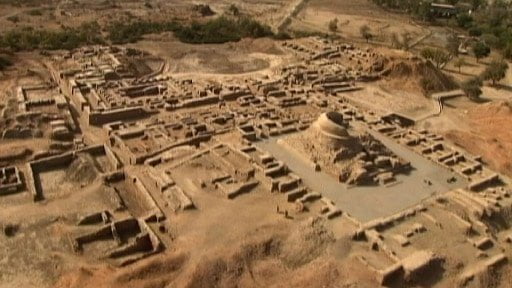
One of the oldest civilizations on this list, the Indus Valley culture lies at the very heart of subsequent civilizations that arose in the region of the Indus Valley. This civilization flourished in areas extending from what is today northeast Afghanistan to Pakistan and northwest India. Forth with Ancient Arab republic of egypt and Mesopotamia, it was one of three early civilizations of the ancient world, and of the three, it was the most widespread, covering an surface area of one.25 million kilometers.
Entire populations were settled in the Indus river basin, one of the major rivers in Asia, and another river named Ghaggar-Hakra which once used to flow through northeast India and eastern Pakistan.
Too known equally the Harappan civilization and the Mohenjo-Daro civilization, named after the earthworks sites where the remains of the civilization were found, the peak stage of this civilisation is said to have lasted from 2600 BC to effectually 1900 BC. A sophisticated and technologically advanced urban civilisation is axiomatic in the Indus Valley civilization making its uppercase the kickoff urban center in the region.
The people of the Indus Valley civilization achieved great accuracy in measuring length, mass, and time, and based on artifacts institute in excavations, it is evident that the culture was rich in arts and crafts as well.
1. The Mesopotamian Civilization
Civilization Proper noun: Mesopotamian civilization
Catamenia: 3500 BC–500 BC
Original Location: Northeast by the Zagros mountains, southeast past the Arabian plateau
Current Location: Republic of iraq, Syrian arab republic, and Turkey
Meaning: Country between rivers (ancient Greek)
Major Highlights: First civilization in the world
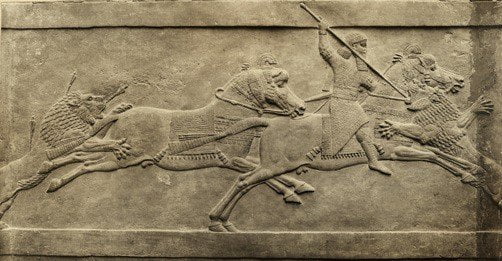
And here information technology is, the first civilization to take always emerged. The origin of Mesopotamia dates back and then far that in that location is no known evidence of any other civilized society earlier them. The timeline of ancient Mesopotamia is normally held to exist from around 3300 BC to 750 BC. Mesopotamia is generally credited as being the beginning place where civilized society truly began to take shape. It was somewhere around 8000 BC that people adult the idea of agronomics and slowly started to domesticate animals for both food and to assist in farming.
People had already been creating art well earlier the Mesopotamians, merely this was office of human civilisation, non man civilisation. It was the Mesopotamian culture that refined this, adding to and formalizing all these systems, and combining them to create the first civilization. They prospered in the regions of modern-day Iraq, and so known as Babylonia, Sumer, and the Assyria Highlands.
See also:
- Pinnacle xi Inventions and Discoveries of Mesopotamia
- Epic of Gilgamesh
Determination
Modernistic-day civilisation and civilization owes a lot to the earliest civilizations that emerged after millions of years of human evolution. Human civilization has come a long way from an historic period when in that location were no defined ways of advice and hunting was the primary source of food. Gradually, agriculture took over from foraging, animals were domesticated, societies were created and adult, and eventually led to the societies that we live in today. Each private civilization listed here contributed in many ways: new inventions, new ideas, new cultures, philosophies, lifestyles, etc. From the very cradle of civilization to the modern day, what we accept go is a result of all civilizations that came earlier.
Bonus: How Ancient Civilizations Started (Video)
delfabbrofess1996.blogspot.com
Source: https://www.ancienthistorylists.com/ancient-civilizations/10-oldest-ancient-civilizations-ever-existed/
0 Response to "Which One of These Ancient Civilization Created Art for Arts Sake?"
Post a Comment